

Work At Height
July 26, 2021
Monday, July 26, 2021


Saturday, July 24, 2021
Notes
July 24, 2021
Immediate Causes vs Underlying Causes vs Root Causes & Unsafe Act vs Unsafe Condition
Immediate Causes vs Underlying Causes vs Root Causes & Unsafe Act vs Unsafe Condition
Accidents occur at the workplace due to a lot of reasons and their investigation as well as implementation of necessary control measures is necessary to prevent the further occurrence. For this purpose, establishing the cause of the accident is a fundamental part of investigation.
The reasons/causes behind an accident are often divided into 3 categories mentioned below;
- Immediate Cause
- Underlying Cause
- Root Cause

The above mentioned terms may vary but the most important thing here is to look beyond the consequences and symptoms of the accident. Being an HSE Professional/ Incident Investigator it is necessary and first priority to dig deep and discover that why the accident occurred or why it was allowed to take place? Usually, the accident occurs due to a chain of event occurring in a series or chain. Each event triggers the next event and this process goes on until the accident takes place.
Immediate Cause
It is the Direct Cause of the accident. e.g., the actual agent of the injury or damage, such as the sharp blade of the machine.
Underlying Cause
It is the less obvious or organizational reasons behind an accident. e.g., no inspection of the machinery before start of job.
Root Cause
It is the main reason behind the accident and result of failure of management, organizational, and planning.

Tuesday, July 20, 2021

Monday, July 19, 2021
Notes
July 19, 2021
Non-Governmental Influential Parties' Role in Setting Health and Safety Standards
Non-Governmental Influential Parties' Role in Setting Health and Safety Standards
The following parties have an important role to play in enhancing the performance of an organization/country towards health and safety of the workers at workplace. These non-governmental influential bodies force an organization to adopt correct measures and protect its workers, public, environment when it comes to health and safety.
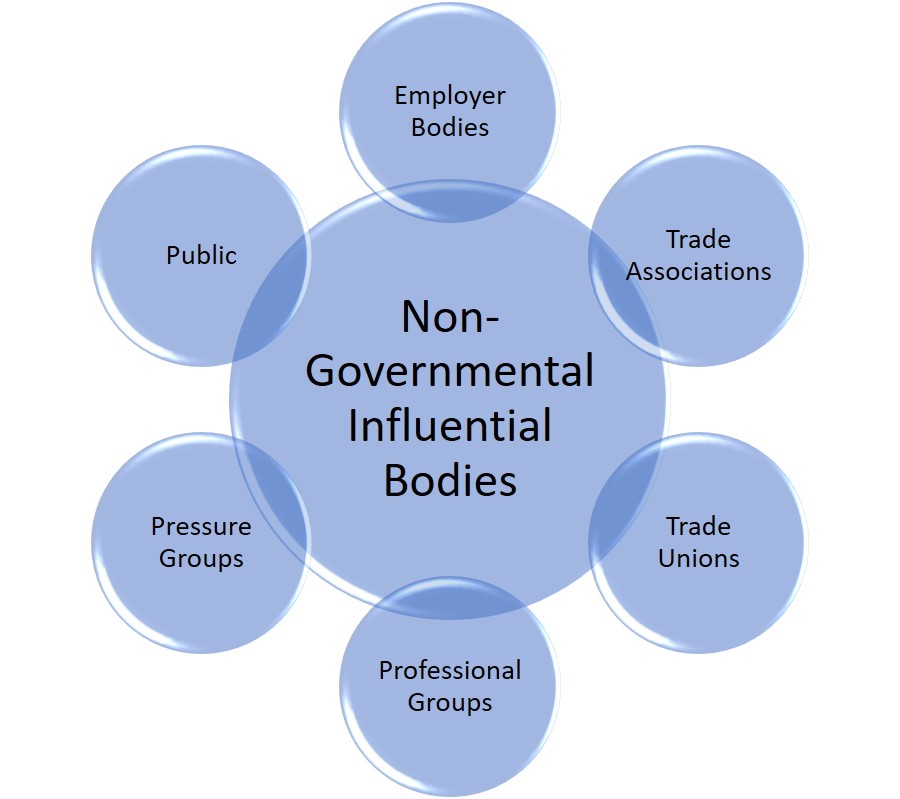
The above mentioned bodies along the media play an important role. Role of the print, broadcast, and social media has been discussed in the previous article that can be read here.
1. Employer Bodies
Such kind of organization consists of the employers or organizations to represent their interests. For example, in Pakistan Chamber of Commerce is established. Chamber of commerce helps in creating and sustaining the conditions in which businesses in the country can compete, grow and run smoothly in compliance of national regulations.
Similarly, in United Kingdom, Confederation of British Industry (CBI) is established to help industry in growing and sustaining business conditions.
Chamber of Commerce or Confederation of British Industry not only work on national level but they also work on international level where they introduce country and its product on international level and attract investment from other countries.
2. Trade Associations
Trade associations are found from a membership of the companies working in a particular area of commerce and exist for their own benefit. These organizations have ability to promote health, safety, environment standards through sharing and implementing guidelines, notes, information, codes of practice etc.
Meetings, workshops, and seminars can be arranged depending on an association's membership, both internationally and at a national/ regional level, to enable networking and the exchange of information and ideas, e.g., on technical and safety issues.
3. Trade Unions
Trade Union is an organization of the workers who work and put their interest in front of government, employer and other regulatory bodies. They work with employer too to achieve the common goals such as wage, hours and working conditions. Trade Unions negotiate with the employing body on behalf of the workers.
The negotiations include, wages, working hours, termination procedure, complain procedure, training and development, incident investigations etc.
4. Professional Groups
Professional Group is an organization or institute working in particular profession and have achieved a defined level of competence. To get membership of the organization, participants pay an amount of fee and enjoy multiple benefits in return. These benefits include guidance, training and development, information exchange as well as recognition on national and international level. Three main Professional groups have been mentioned below with little summary of introduction.
4.1 Institute of Occupational Safety & Health - IOSH
IOSH is a United Kingdom based organization and worldwide recognized as well. The organization is engaged in providing information, guidance, as well as other resources. IOSH covers more than 30,000 members across the globe and around 10,000 Chartered Safety & Health Practitioners across the globe. Its a not-for-profit and independent organization and accepted by International Labour Organization as a non-governmental organization.
4.2 American Society of Safety Engineers/Professionals - ASSE/ASSP
American Society of Safety Engineers/Professionals also known as ASSE/ASSP is an American based organization and world's oldest safety body, engaged in expanding the expertise of its members and providing information about Health and Safety at workplace. It also sets and implements Health and Safety standards.
4.3 Board of Certified Safety Professionals - BCSP
Board of Certified Safety Professionals (BCSP) a Peer Certification board. It is not providing any kind of membership or services provided by member organizations but it's prime responsibility is to provide training and certify professionals. There is always a need for certified and trained safety professionals as there are standards and laws require certified safety professionals.
5. Pressure Group
Pressure Group is an organization which has common interest but never put up candidates for election purpose. Pressure Groups are always engaged in raising the issues and pressuring the concerned parties to take action and resolve issues.
In terms of Safety and Health at work, these Pressure Groups pressurize the government to make legislation and implement safety and health laws. In other words, they lobby against the government and highlight the issues and make government to take remedial actions.
6. General Public
General Public never expects that their beloved one risk his/her life for the economical profit of the organization, he/she is working for. They want that their beloved ones are safe at workplace and organization is providing them with all resources needed to perform the job.

Saturday, July 17, 2021

Friday, July 16, 2021

Wednesday, July 14, 2021

Tuesday, July 13, 2021
Notes
July 13, 2021
Role of the Print, Broadcast, and Social Media in a Implementing Health and Safety at the Workplace

The media plays an important role in highlighting the issues on daily basis. Similarly here in Health and Safety, social media, print media, followed by Broadcast media can play an effective and important role in implementing health and safety standards at workplace and influence changes in attitude towards health and safety.
Types of Media
There are 3 types of media which include the following;
- Print Media e.g., Newspaper, Magazine, Leaflets, Books, Journals
- Broadcast Media e.g., Radio, Television
- Social Media e.g., Websites, Facebook, Instagram, Twitter, YouTube
- Ensuring Health and Safety guidelines are easily available with minimum cost. Agencies like OSHA (US), HSE (UK) provide guidance for all kind of activities being done by all kind of people, to comply with legal requirements. These guidelines are available in all kind of forms e.g., printed form and electronic form.
- With the help of the social media, print media, and broadcast media, major accidents/ incidents can be published and awareness can be spread. Not only this, prosecution and inquires can be published as well. Major disasters can be discussed publicly not only in the country where it origin. Through this, public can get awareness and effective controls can be adopted. Those who have been sentenced by government for negligence, their cases can be shared with public so that no one else repeat. Further, government and NGOs can use these media mediums to spread awareness through campaigns, programs and tv shows.
- Publish professional journals with the help of educational institutes and spread awareness.
- Those who have internet connection, must be able to access huge amount of information about health and safety without any cost.
The Media houses and platforms can change the attitude of public and employer by publishing;
- Legal Requirements and consequences of non-compliance
- Sharing duty holder's responsibilities imposed on him/her by government/ regulatory bodies
- Publication of good health and safety performance so that other organizations adopt same standards and improve their service quality, performance, and reputation.

Friday, June 11, 2021
Procedure
June 11, 2021
Confined Space Work Procedure
Confined Space Entry Work Procedure
Note: The procedure can be modified according to the need of the organization, activity is being performed, and other factors which are different from this procedure. Confined Space Entry Work Permit can be download from the following here.
 |
Thursday, June 10, 2021
Inspection
June 10, 2021
General Work Environment Checklist

Wednesday, June 9, 2021
Notes
June 09, 2021
Role of International Labor Organization in Setting Global Health and Safety Standards
ILO Role and International Labor Conference

International Labor Organization was established in 1919, as a part of the Treaty of Versailles that ended World War 1(WW1). Its main aim is to promote rights at work, encourage decent employment opportunities, enhance social protection and strengthen dialogue in handling world-related issues.
ILO is an agency of the UN that is devoted to advancing opportunities for women and men to obtain decent and productive work in conditions of freedom, equality, security, and human dignity. It is the only Tripartite United Nations agency that brings the representatives of governments, employers, and workers to jointly shape policies and programs.
It is a global body responsible for developing and monitoring international labor standards. 181 countries are members of this organization and working with them, ILO ensures the labor standards are respected in practice.
So far, ILO has adopted more than 180 conventions and 190 recommendations covering all aspects of the world of work, and nearly half of these conventions are relevant to Health and Safety.
Every Year in June, ILO members meet in Geneva, Switzerland where each state is represented by a delegate. Each delegate consists of two government delegates, an employer delegate, a worker delegate, and their respective advisers.
Every delegate has the same right, and all can express themselves freely and vote as they wish, worker and employer delegates may vote against their government's representatives, or against each other. Many of the government representatives are cabinet ministers responsible for labor affairs in their own countries. Heads of states also participate in the conference. A two-thirds majority is required before they can be adopted.
ILO Convention
The adoption of a convention by the ILO Conference allows the government to ratify it, and when a specified number of governments have done so, the convention becomes a treaty in international law. All ILO conventions are considered Labor standards, irrespective of how many governments have ratified them.
Ratification of a convention imposes a legal obligation to apply its provision. It is voluntary for a country to ratify a convention. If states don't ratify a convention, it has the same legal force as the recommendation. Each government is bound to submit a report about its compliance with its ratified convention, and an ILO Committee examins report to find out the breaches of labor standards.
An example of a convention is the Occupational Safety and Health Convention 1981 and its protocol of 2002.
Monday, June 7, 2021
Notes
June 07, 2021
Loss Events and Compensatory Schemes Available for Employers
Loss Events in Terms of Failure in the Duty of Care to Protect the Worker and Compensatory Schemes Available for an Employer

If a worker has a work-related incident at the workplace or comes in contact with a disease as a result of work he is undertaking, it may result in a loss that may include pain, suffering as well as loss of future income. This incident or ill-health may lead to the death of the worker, which will result in the worker's dependents suffering a major financial setback.
Over the passage of time, there are various mechanisms that have evolved to compensate the injured workers in case of an accident or provide financial aid to the dependents of the worker if the worker loses a life.
The mechanism is to compensate the victim but this system is divided into sub-categories listed below;
- Compensatory Scheme
- No-Fault Compensation Scheme
- Fault Compensation Scheme
Compensatory Scheme
The main purpose of this mechanism is to compensate the victim. The mechanism can be divided into two schemes where it is;
- Not Necessary to prove that the employer was at fault
- Has to Prove that the defendant (employer) was at fault
Method 1: No-Fault Compensation Scheme
There is no need to prove the fault of the employer/ defendant but it is to establish that the harm was caused as a result of the person's employment. Usually, No-Fault Compensation Schemes fall into one of the two main categories;
- Employer provides benefits - The employer gets his employees insured, pays a premium to the insurance company, who in case of incident and harm to worker pays compensation to the victim.
- The Government or Government Agencies provide the benefits. The system consists of social insurance operated by the government or an agency of the government.
Scheme 1: Employer's Scheme
Here the employer is liable to provide benefits to the worker. The scheme is operated by the Insurance Companies. An employer who hires workers to work on his behalf pays Premium to the insurance companies. Many countries through their legislation, require that the workers should be insured.
In case of any accident or illness, the claim is made by the worker and the insurance company pays compensation to the claimant on behalf of the employer. In other words, it is the return of the premium, employer-paid as insurance money to the insurance company.
Scheme 2: Social Insurance Scheme
These schemes are administrated by the government and funded by compulsory contributions made by the employer, worker, both with possible further contributions made from general taxation. These contributions may be at a fixed rate or maybe earnings-related.
If a claim is made by the injured worker, a medical examination is done to establish the nature of the harm or loss whether any recovery is likely. If the disability is permanent, then a pension is paid, instead of a lump-sum amount by the government department.
An example of such a scheme is the British Industrial Disablement Benefits Scheme which is funded by the employees, employers, and taxation. The benefit is paid to someone who has suffered the loss of faculty due to an accident at work or has a prescribed industrial disease associated with the person's occupation. The Compensation is paid to employees only, not to self-employed ones.
Method 2: Fault Compensation Scheme
Most jurisdictions make an employer liable for injury or illness to a worker as a result of their occupation. This requires the injured worker to file a case in the civil court of that country against the employer and the need to establish fault on the part of the employer, or one of his/her workers.
In simple words, the claimant has to prove that the harm was caused by the negligence of the employer or one of his employees or that there has been a breach of health and safety legislation.
The liability of the employer may come about in two ways;
- The employer is responsible for his or her own acts of negligence and it is called Primary Liability.
- The employer may be Vicariously Liable for the negligence of his/her workers who committed the wrongful act in their course of employement.

Saturday, June 5, 2021
Workplace Safety Management
June 05, 2021
Hot Work Work Permit Form

Wednesday, June 2, 2021

Tuesday, June 1, 2021
Notes
June 01, 2021
Benefits and Limitations of Integrating Occupational Health and Safety Management Systems
Benefits and Limitation of Integrating Occupational Health and Safety Management Systems
Or
Merits and Demerits of Integrating Occupational Health and Safety Management System
Advantages and Disadvantages of Integrating Occupational Health and Safety Management Systems

Every system has advantages and disadvantages when they are integrated with other systems to construct a system. For example, an organization has 3 different systems ISO 9001 QMS, ISO 14001 EMS, ISO 45001 OHSMS as a stand-alone system. If they are integrated, their merits and demerits will be the same, and sometimes these merits and demerits will be countering each other.
Few Benefits and Limitations of Integrating Management Systems (IMS) are listed below;
Benefits
- A well-planned Integrated Management System is expected to work more cost-effectively than stand-alone systems.
- Facilitates decision-making that reflects the actual need of the organization.
- IMS provides more rewarding opportunities for specialists in each discipline.
- objectives and processes are essentially the same - no difference.
- No duplication - recordkeeping, auditing, software, meetings are the same.
- A positive culture in one system may be carried over to others.
- Timely system review.
- Integration may threaten the coherence and consistency of the current system that is supported by everyone. The existing system may be working very well already.
- Specialists may continue to focus on their area of specialty and further training may not be required.
- Uncertainty regarding key terms.
- System requirements may vary regarding to topics cover. e.g., Quality Management System (QMS) will be simple, but the HSE Management system can be complex.
- Quality Management System Requirements are determined by Customer Satisfaction while the OHSMS requirements are underpinned by national legislation and standards.
- Single topic auditors may have difficulty in evaluating their part of the IMS.
- A Negative culture in one topic may be carried over to others.


 Posts

